What Are the 12 Main Branches of Science?


Branches of science form the foundational framework for understanding the natural and social world, each focusing on a distinct aspect of reality through systematic study and evidence-based inquiry. From the subatomic particles that constitute matter to the vast complexities of human societies, how do these disciplines interconnect to build our collective knowledge? What is the difference between a natural science and a formal science, and why is this classification crucial? This comprehensive guide explores the 12 primary branches of science, detailing their core principles, key questions, and their indispensable roles in driving innovation and addressing global challenges. Understanding this taxonomy is the best way to appreciate the scope and impact of human discovery.
What Are the Three Overarching Categories of Science?
Before delving into specific branches, it is essential to understand the high-level categorization that organizes scientific inquiry. What is the difference between Natural Sciences, Formal Sciences, and Social Sciences? This tripartite structure is based on the subject of study and the methodologies employed.
Natural Sciences seek to understand the rules that govern the natural, physical universe. They rely heavily on empirical evidence, observation, and experimentation. How can you identify a natural science? Its phenomena are testable and measurable, such as the reaction of chemicals or the motion of celestial bodies. This category includes physics, chemistry, and biology.
Formal Sciences are concerned with abstract systems and formal structures. They deal with logic, mathematics, and theoretical computer science. Is it worth considering them “true” sciences? While they do not study the physical world, they provide the essential logical and quantitative frameworks that all empirical sciences depend on for modeling, prediction, and analysis.
Social Sciences explore the intricacies of human society and relationships. They apply scientific methods to study economics, psychology, sociology, and political science. What are the pros and cons of their methodology? While they strive for objectivity, the complexity of human behavior can make it challenging to establish universal laws compared to the natural sciences.
What Are the Core Natural Sciences and Their Sub-Disciplines?
The natural sciences are often the first that come to mind when thinking of “science.” Which branches fall under this umbrella, and what specific questions do they answer?
-
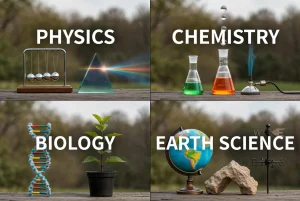
Physics: The fundamental science of matter, energy, space, and time. How does it explain the universe? It seeks to understand forces, motion, and the behavior of the universe at every scale, from quarks to galaxies. Key sub-disciplines include mechanics, thermodynamics, quantum physics, and astrophysics.
-
Chemistry: The study of the composition, structure, properties, and changes of matter. What is the best way to understand its scope? It bridges physics (with fundamental particles) and biology (with complex molecules of life). Organic, inorganic, physical, and analytical chemistry are its primary divisions.
-
Biology: The science of life and living organisms. How many levels does it encompass? It ranges from molecular biology and genetics to zoology, botany, and ecology, studying everything from cellular processes to entire ecosystems.
-
Earth Science (Geoscience): This branch focuses on the planet we inhabit. When should you consider it a distinct field? It integrates principles from physics, chemistry, and biology to understand Earth’s systems. Its main sub-fields are geology (solid Earth), oceanography (oceans), meteorology (atmosphere), and astronomy (celestial bodies beyond Earth).
What Are the Principal Formal Sciences?
The formal sciences provide the “language” and logical structure for other sciences. How do they operate without empirical experimentation?
-
Mathematics: The science of numbers, quantities, shapes, and logical reasoning. Why is it considered the backbone of science? It provides the models, equations, and statistical tools used to formulate theories and interpret data in virtually every other field, from physics to economics.
-
Logic: The study of valid reasoning and argumentation. What should a scientist understand about logic? It underpins the scientific method itself, ensuring that conclusions follow soundly from premises and evidence. It is crucial for computer science algorithm design and philosophical inquiry.
-
Computer Science: The systematic study of the theory, experimentation, and engineering that form the basis for the design and use of computers. How far does its influence reach? While a modern discipline, it is rooted in formal logic and mathematics and now drives innovation in data analysis, simulation, and artificial intelligence across all other sciences.
What Are the Key Social Sciences?
The social sciences apply scientific principles to understand human behavior, which is often less predictable than physical phenomena. Which fields are essential for understanding societal structures?
-
Psychology: The scientific study of the human mind and behavior. What is the difference between clinical psychology and cognitive psychology? It explores mental processes, emotions, development, and personality, with applications in therapy, education, and organizational behavior.
-
Sociology: The study of human societies, their interactions, and the processes that preserve and change them. How can you analyze social trends? It examines institutions, social stratification, race, gender, and culture to understand group dynamics and societal change.
-
Anthropology: The holistic study of humanity, past and present. How long has it been a formal science? It combines cultural, social, biological, and archaeological perspectives to understand human diversity and evolution across time and space.
-
Economics: The social science that analyzes the production, distribution, and consumption of goods and services. What are the best ways to model economic behavior? It uses mathematical models and empirical data to study markets, policy impacts, and resource allocation at individual and national levels.
-
Political Science: The study of politics, governance systems, and political behavior. How does it differ from casual political commentary? It applies scientific methods to analyze political activities, thoughts, constitutions, and international relations, seeking to understand power dynamics and policy outcomes.
How Do These Branches Interconnect and Collaborate?
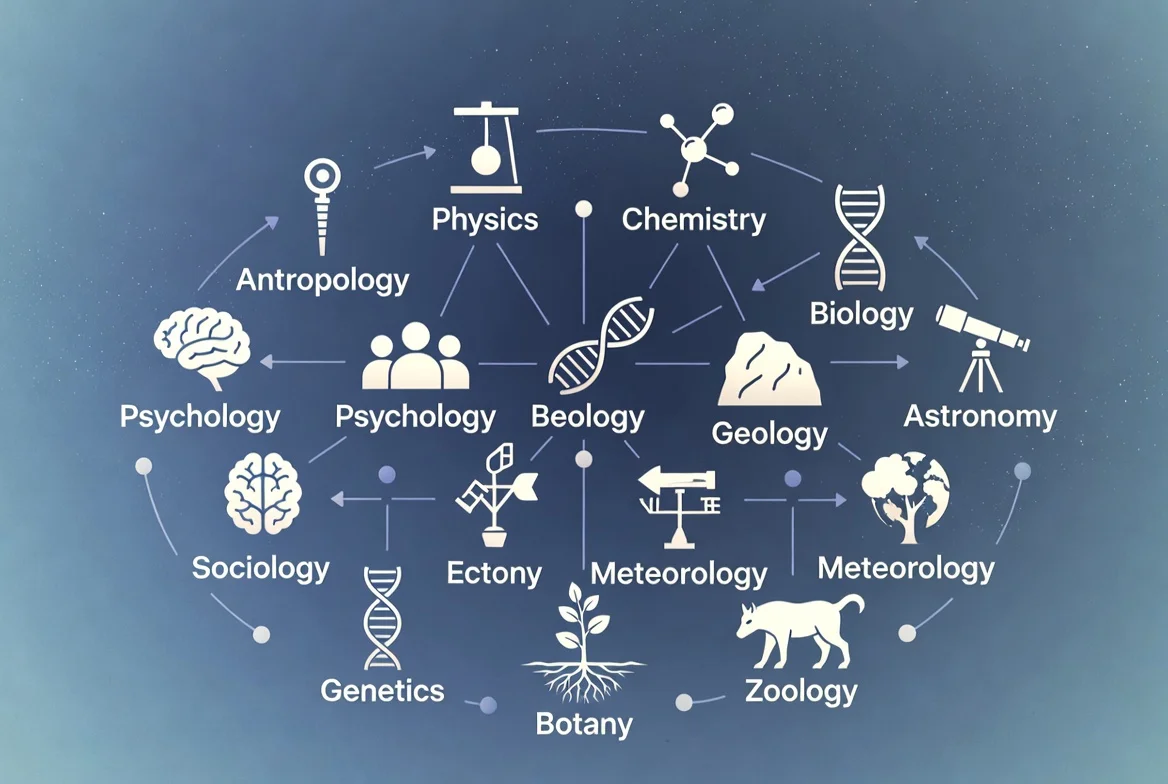
In the modern research landscape, the most groundbreaking discoveries often occur at the intersection of scientific branches. What is the best way to see this synergy? Fields like biochemistry (biology + chemistry), astrophysics (physics + astronomy), and cognitive science (psychology + computer science + neuroscience) are inherently interdisciplinary.
How can you categorize emerging fields? Disciplines like environmental science, data science, and biomedical engineering are not standalone “core” branches but are powerful synthetic fields that draw upon multiple foundational sciences to solve complex, real-world problems. This collaborative trend is one of the top drivers of innovation in the 21st century, demonstrating that the traditional boundaries between sciences are becoming increasingly porous and collaborative.
Frequently Asked Questions (FAQs)
1. What is the difference between a branch of science and a sub-discipline?
A branch of science (like Physics or Biology) is a major, fundamental category of scientific study with its own core principles. A sub-discipline (like Thermodynamics or Microbiology) is a specialized field within a major branch, focusing on a more specific set of phenomena or questions.
2. Are there really only 12 branches of science?
The number 12 represents the principal, widely recognized core branches. However, science is ever-evolving. Many experts might list slightly different groupings or include modern interdisciplinary fields. This list covers the foundational categories from which all other specialized fields derive.
3. Which branch of science is considered the most fundamental?
Many scientists and philosophers point to Physics as the most fundamental. It seeks to understand the basic laws governing energy, matter, and their interactions, which underpin all chemical, biological, and geological processes.
4. Is history considered a branch of science?
History is traditionally classified as one of the Humanities, not a formal social science. While it uses systematic research methods, its focus on interpreting unique past events, rather than discovering general laws of human behavior, typically places it outside the core scientific branches. However, fields like archaeology (within Anthropology) apply scientific techniques to historical study.
5. Where do engineering and medicine fit in?
Engineering is the application of scientific principles (primarily from physics, chemistry, and mathematics) to design and build structures, machines, and systems. Medicine is the applied practice of maintaining and restoring health, heavily based on the biological sciences. They are considered applied sciences, whereas the 12 branches listed are primarily basic or pure sciences focused on fundamental understanding.
6. What is the newest branch of science?
Among the formal branches, Computer Science is one of the newest, emerging as a distinct academic discipline in the mid-20th century. In terms of interdisciplinary fields, areas like Data Science, Synthetic Biology, and Quantum Information Science are among the most recent and rapidly evolving.
7. How should a student choose which branch to study?
Consider your core interests: Do you enjoy abstract reasoning (Formal Sciences), experimenting with physical materials (Natural Sciences), or understanding people and societies (Social Sciences)? The best way to decide is to explore introductory courses in each category and seek out hands-on project experiences.
Disclaimer: The classification of scientific branches is a conceptual framework used to organize knowledge. Different educational institutions and scholarly traditions may use alternative categorizations or include additional fields. The information provided here is for educational purposes and represents a widely accepted overview within the Western scientific tradition.
Keywords: branches of science, natural sciences, social sciences, formal sciences, what are the branches of science, list of sciences, physics chemistry biology, earth science, mathematics, computer science, psychology, sociology, anthropology