The 7 Major Branches of Natural Science

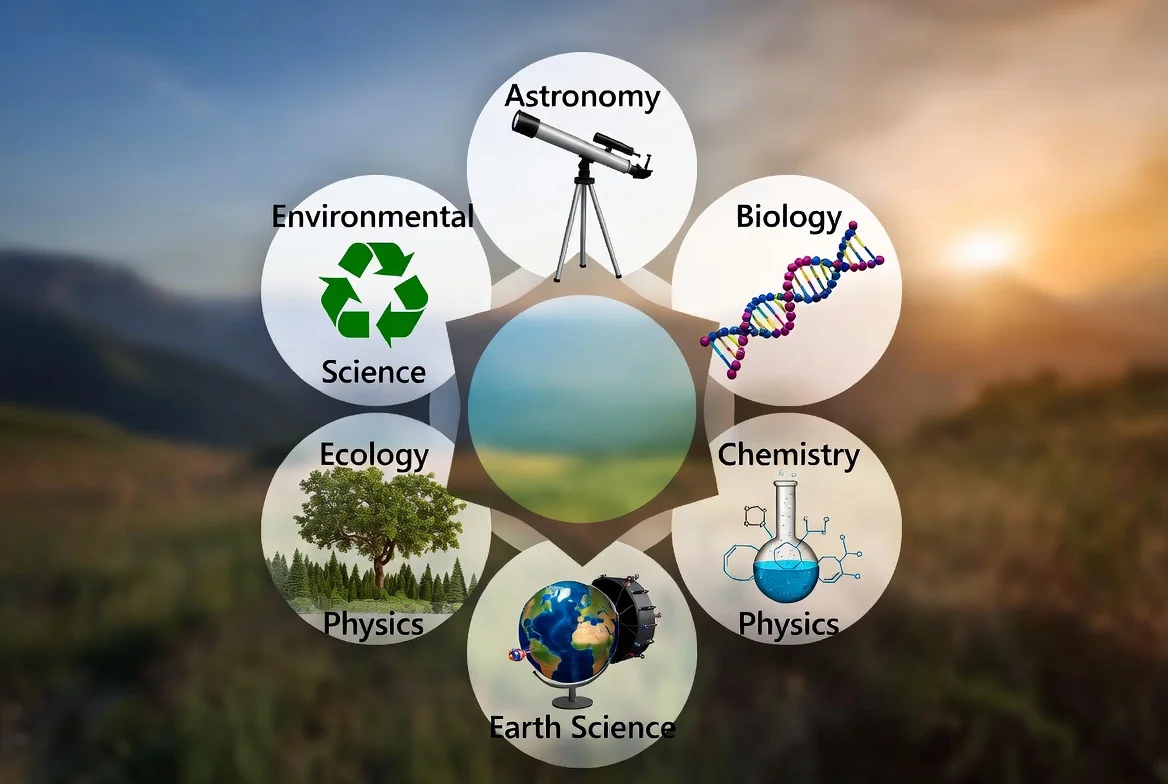

Natural sciences form the systematic study of the physical and material world through observation, experimentation, and evidence-based reasoning. What exactly constitutes a natural science, and how are these fields categorized to decode the universe’s fundamental principles? This comprehensive guide explores the seven major branches, detailing their core focuses, methodologies, and why their interplay is essential for a holistic understanding of reality. From the subatomic to the cosmic scale, these disciplines provide the framework for all technological and medical advancements.
1. What is Physics and How Does it Define the Fundamental Laws of the Universe?
Often considered the most fundamental natural science, physics seeks to understand the properties and interactions of matter, energy, space, and time. What are the key questions physics aims to answer? It explores everything from the behavior of subatomic particles to the dynamics of galaxies. This branch is traditionally divided into classical physics (mechanics, thermodynamics, electromagnetism) and modern physics (relativity, quantum mechanics). How does its methodology work? Physics relies heavily on mathematical modeling, controlled experiments, and theoretical prediction. Its laws, such as Newton’s laws of motion or Einstein’s theory of relativity, provide the foundational rules that govern all other natural phenomena, making it the cornerstone upon which other sciences build.
2. How Does Chemistry Study Matter at the Atomic and Molecular Level?
Chemistry is the science of matter—its composition, structure, properties, and the changes it undergoes during chemical reactions. What is the difference between its main sub-disciplines? Organic chemistry focuses on carbon-containing compounds central to life, while inorganic chemistry studies metals, minerals, and other non-carbon compounds. Physical chemistry applies physics principles to chemical systems, and analytical chemistry focuses on identifying and quantifying matter. How can you see its application? From developing new pharmaceuticals and materials to understanding environmental processes, chemistry explains the molecular interactions that shape our world. It acts as the crucial bridge between the laws of physics and the complexity of biology.
3. What Does Biology Reveal About the Complexity of Life and Living Organisms?
Biology is the exploration of life and living organisms, including their structure, function, growth, origin, evolution, and distribution. How many levels of organization does it encompass? It ranges from the molecular scale (molecular biology, biochemistry) to entire ecosystems (ecology). Key subfields include genetics (study of heredity), zoology (animals), botany (plants), microbiology (microorganisms), and physiology (functions of organisms). What is the best way to understand its unifying theory? The theory of evolution by natural selection, first comprehensively articulated by Charles Darwin, provides the central framework that connects all biological research, explaining the dazzling diversity of life on Earth.
4. How Does Astronomy Explore the Cosmos Beyond Our Planet?
Astronomy is the study of celestial objects and phenomena that originate outside Earth’s atmosphere. This includes stars, planets, galaxies, nebulae, and cosmic background radiation. What are the primary tools of an astronomer? While observation is key—using telescopes across the electromagnetic spectrum—modern astronomy heavily incorporates physics (astrophysics) and chemistry (astrochemistry) to interpret data. How far can it see? It deals with immense scales of space and time, investigating the universe’s origin (cosmology), the life cycle of stars, and the potential for life elsewhere. Unlike most sciences, it is primarily observational rather than experimental, as we cannot physically manipulate distant stars and galaxies.
5. What is the Focus of Earth Science on Our Dynamic Planet?
Earth science (or geoscience) is the holistic study of our home planet. It integrates geology, oceanography, meteorology, and environmental science to understand Earth’s past, present, and future. Which components does it analyze?
-
Geology: The solid Earth—rocks, minerals, plate tectonics, and geological history.
-
Oceanography: The oceans—their chemistry, physics, geology, and biology.
-
Meteorology & Climatology: The atmosphere—weather patterns, climate systems, and atmospheric processes.
-
Environmental Science: The interaction between humans and Earth’s systems.
How does this science directly impact society? It is critical for resource management, natural hazard prediction (earthquakes, hurricanes), and understanding climate change.
6. How is Ecology Distinct as the Study of Organisms and Their Environment?
While rooted in biology, ecology has grown into a distinct, interdisciplinary natural science focused on the relationships between living organisms and their physical and biological environment. What does it investigate? It examines ecosystems, biodiversity, the flow of energy and nutrients, and population dynamics. What are the pros and cons of its applied arm, conservation biology? It provides essential knowledge for preserving habitats and species, but its recommendations often clash with economic and political interests. Ecology operates at multiple scales, from an individual organism (autecology) to entire global systems (global ecology).
7. Why is Atmospheric Science a Critical Standalone Discipline?
Atmospheric science is a specialized branch of Earth science that focuses exclusively on Earth’s atmosphere, its processes, and its interactions with other systems. How is it different from simple weather forecasting? It applies physics and chemistry to understand atmospheric phenomena, including weather (meteorology), long-term climate trends (climatology), and atmospheric physics/chemistry. Which tools does it use? Satellites, radar, weather balloons, and sophisticated computer models. In 2026, its role is more critical than ever in modeling climate change, predicting severe weather events, and studying air quality and pollution.
Table: Core Focus & Key Questions of the 7 Natural Sciences
| Branch | Core Focus | Primary Scale | Key Question it Seeks to Answer | Example Sub-discipline |
|---|---|---|---|---|
| Physics | Fundamental laws of nature | Subatomic to Cosmic | “What are the fundamental forces and constituents of the universe?” | Quantum Mechanics, Thermodynamics |
| Chemistry | Composition & change of matter | Atomic & Molecular | “How do substances interact and transform?” | Biochemistry, Organic Chemistry |
| Biology | Life and living organisms | Molecular to Ecosystem | “What are the principles that govern life?” | Genetics, Ecology, Zoology |
| Astronomy | Celestial objects & the universe | Planetary to Cosmological | “What is the origin and fate of the universe?” | Astrophysics, Planetary Science |
| Earth Science | Systems of planet Earth | Global & Local | “How do Earth’s geospheres interact and evolve?” | Geology, Oceanography, Glaciology |
| Ecology | Interactions in the biosphere | Population to Biosphere | “How do organisms interact with each other and their environment?” | Conservation Ecology, Population Ecology |
| Atmospheric Science | Earth’s atmospheric processes | Local to Global | “How do atmospheric processes drive weather and climate?” | Meteorology, Climatology, Aeronomy |
How Do These Natural Sciences Interconnect and Rely on One Another?
The boundaries between these seven branches are fluid and increasingly interdisciplinary. What is the best way to view their relationship? They exist on a continuum of scale and complexity.
-
Physics provides the foundational laws.
-
Chemistry applies these laws to atoms and molecules.
-
Biology arises from complex chemical systems.
-
Earth, Atmospheric, and Ecological Sciences study the planetary and environmental systems that support life.
-
Astronomy places Earth and its systems in the context of the wider cosmos.
Modern challenges like climate change, pandemics, or space exploration cannot be addressed by a single discipline. They require a convergent approach, integrating tools and knowledge from across the natural sciences.
What Are the Common Methodologies That Unite All Natural Sciences?
Despite their different subjects, all natural sciences share a core commitment to the scientific method. How does this process work? It involves making observations, forming a testable hypothesis, conducting experiments or gathering further data, analyzing results, and drawing conclusions that can be peer-reviewed and replicated. What is the difference between a theory and a law in this context? A scientific law (e.g., law of gravity) describes a observed phenomenon, while a scientific theory (e.g., theory of evolution) provides a well-substantiated explanation for that phenomenon. Both are cornerstones of robust scientific understanding.
Frequently Asked Questions (FAQs)
1. Is mathematics a natural science?
No, mathematics is generally classified as a formal science, not a natural science. While it is the primary language and tool of the natural sciences, it does not study the natural world through empirical evidence. It deals with abstract structures, logic, and relationships based on axioms and theorems.
2. What is the difference between natural science and social science?
Natural sciences (e.g., physics, biology) study the physical, material, and non-human world using objective, quantitative, and empirical methods. Social sciences (e.g., psychology, sociology, economics) study human behavior, societies, and relationships, often incorporating qualitative methods and dealing with greater complexity and subjectivity in variables.
3. Which natural science is considered the “hardest”?
This is subjective and depends on individual aptitude. However, physics is often cited due to its high level of mathematical abstraction and conceptual challenges in areas like quantum mechanics and relativity. Chemistry and advanced biology (e.g., biochemistry) also present significant complexity at their higher levels.
4. How is ecology different from environmental science?
Ecology is a core biological/natural science focused on understanding the interactions within the natural world. Environmental science is an interdisciplinary applied field that uses principles from ecology, geology, chemistry, and social sciences to solve practical problems related to human impact on the environment, such as pollution and waste management.
5. Are computer science and engineering considered natural sciences?
No. Computer science is a formal/theoretical science related to mathematics. Engineering is an applied science that uses knowledge from the natural sciences to design, build, and maintain structures, machines, and systems. They are crucial technologies but are distinct from the discovery-based pursuit of fundamental natural knowledge.
6. What is an example of a career in each of the 7 natural sciences?
-
Physics: Particle Physicist, Astrophysicist, Optical Engineer.
-
Chemistry: Pharmaceutical Researcher, Materials Scientist, Analytical Chemist.
-
Biology: Genetic Counselor, Microbiologist, Wildlife Biologist.
-
Astronomy: Planetary Scientist, Cosmologist, Observatory Researcher.
-
Earth Science: Hydrologist, Volcanologist, Geological Surveyor.
-
Ecology: Conservation Scientist, Restoration Ecologist, Wildlife Manager.
-
Atmospheric Science: Climatologist, Broadcast Meteorologist, Air Quality Analyst.
Disclaimer: The information presented in this article is for educational and informational purposes only. The categorization of scientific disciplines can vary among academic institutions, and the fields are constantly evolving with new interdisciplinary areas emerging. For specific academic or career guidance, consulting with educational institutions and professional bodies in the respective fields is recommended.
Keywords: what are the natural sciences, 7 branches of natural science, physics chemistry biology, earth science, astronomy, ecology, atmospheric science, difference between natural and social science, scientific method, interdisciplinary science