The 4 Main Branches of Science

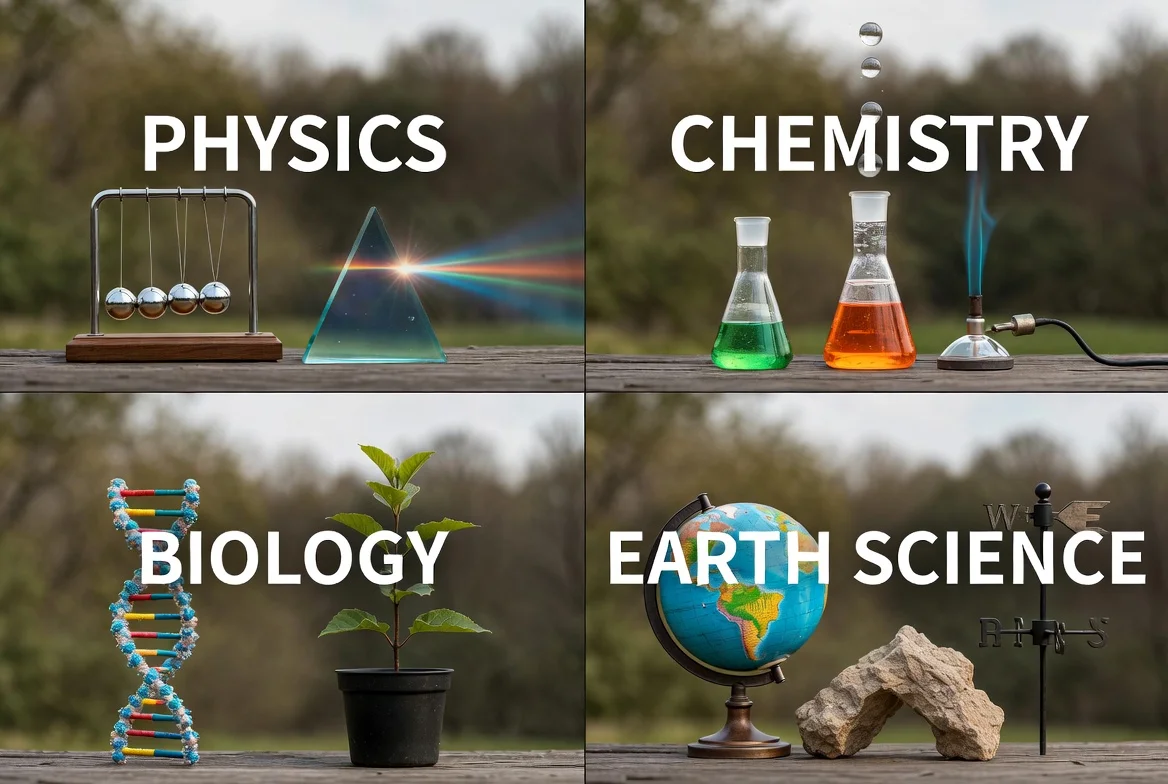

Science is the systematic pursuit of knowledge about the universe through observation, experimentation, and evidence-based reasoning. But how is this vast field organized? What is the best way to categorize different scientific inquiries? Understanding the four main branches—Physical Science, Life Science, Earth and Space Science, and Formal Science—provides a foundational map of human knowledge. Each branch asks distinct questions, employs specific methods, and uncovers fundamental truths about different aspects of reality. This guide explores what defines each branch, their key sub-disciplines, and why their interplay is essential for solving complex modern problems.
What is Physical Science and What Does It Study?
Physical science is the branch that investigates non-living systems and the fundamental forces that govern the universe. How does it form the basis for our understanding of matter and energy? It seeks to answer questions about the composition, structure, properties, and changes of physical entities. The primary sub-disciplines are physics and chemistry, though astronomy and geology also have significant physical science components.
Physics, often considered the most fundamental science, asks: What are the laws governing motion, force, energy, and the structure of atoms? It ranges from quantum mechanics (studying the very small) to cosmology (studying the entire universe). Chemistry focuses on the properties, composition, and transformations of substances. What is the difference between a chemical reaction and a physical change? Chemistry explains the molecular reasons behind these processes. How far does the scope of physical science extend? It underpins modern technology, from semiconductors to pharmaceuticals, making it indispensable for engineering and applied sciences.
How Does Life Science Explore the Living World?
Life science, or biological science, is dedicated to the study of living organisms and life processes. Which questions drive discovery in this branch? It explores the structure, function, growth, origin, evolution, and distribution of life. From the molecular machinery inside a cell to the vast complexity of ecosystems, life science seeks to understand the “what,” “how,” and “why” of life itself.
Key areas include botany (plants), zoology (animals), microbiology (microorganisms), genetics (heredity), and ecology (organisms and their environment). What are the best ways to study such diversity? Life scientists use tools ranging from microscopes and DNA sequencers to field observations and statistical models. A pivotal question in modern life science is: “How can we apply this knowledge to improve health, agriculture, and environmental sustainability?” The field is directly responsible for advancements in medicine, biotechnology, conservation, and food science, addressing some of humanity’s most pressing challenges in 2026.
What Does Earth and Space Science Encompass?
Earth and Space Science is the integrative study of our planet, its neighboring celestial bodies, and the cosmos. Why is this branch critical for our future? It combines geology, meteorology, oceanography, and astronomy to understand Earth’s systems and our place in the universe. This branch answers questions like: How old is the Earth? What factors drive climate change? What are planets and stars made of?
Geology studies Earth’s solid material, history, and processes like plate tectonics. Meteorology and climatology analyze the atmosphere and weather patterns—a field of increasing urgency. Oceanography explores the physical and biological aspects of the oceans. Astronomy, the oldest science, investigates celestial objects and phenomena beyond Earth’s atmosphere. What is the pros and cons of remote sensing versus sample analysis? Earth scientists use both, from satellite imagery to drilling ice cores. This branch is essential for resource management, natural hazard prediction, and understanding climate dynamics, providing crucial data for policy decisions in 2026 and beyond.
How is Formal Science Different from the Other Branches?
Formal science is often considered distinct because it studies formal systems rather than natural phenomena. What does this mean in practice? It deals with abstract concepts established using a priori (from theory) reasoning and logic. The primary types of formal sciences include mathematics, logic, statistics, and theoretical computer science. How can abstract systems describe the real world? While they originate in logic, their frameworks are powerfully applied across all other scientific branches.
Mathematics provides the universal language and tools for quantification, modeling, and proof. Logic is the study of valid reasoning and inference. Statistics offers methods for data collection, analysis, and interpretation, which is the backbone of empirical research in 2026. What is the difference between pure and applied mathematics? Pure mathematics explores abstract concepts for their own sake, while applied mathematics uses those concepts to solve real-world problems in physics, engineering, and economics. Without formal science, the other branches would lack the rigorous structure needed to validate findings and build reliable theories.
How Do the 4 Branches of Science Interconnect and Collaborate?
The boundaries between scientific branches are increasingly porous. Which fields are the best examples of this interdisciplinary fusion? The most groundbreaking work often occurs at these intersections, solving problems that cannot be addressed by one branch alone.
Biochemistry (Biology + Chemistry), Astrophysics (Physics + Astronomy), and Geoinformatics (Earth Science + Computer Science) are classic examples. How does this collaboration work in practice? For instance, developing a new MRI technology requires physics (electromagnetism), engineering (device design), life science (understanding tissue response), and formal science (algorithms for image processing). What are the top challenges tackled by interdisciplinary science in 2026? Climate change mitigation, personalized medicine, artificial intelligence ethics, and space exploration all require teams of specialists from multiple branches. This synergy is the future of scientific innovation, proving that the whole of human knowledge is greater than the sum of its parts.
What Are the Common Methodologies Across All Scientific Branches?
Despite their different subjects, all branches of science share a core commitment to the scientific method. How can a single methodology apply to such diverse fields? The scientific method is a flexible framework for systematic inquiry involving observation, hypothesis formation, experimentation, analysis, and conclusion.
What should a robust scientific experiment include? A testable hypothesis, controlled variables, reproducible procedures, and objective data analysis. How many times must a result be replicated to be accepted? While no fixed number exists, reproducibility by independent researchers is the gold standard for validation. What is the best way to handle contradicting evidence? Good science requires peer review, publication, and the willingness to revise theories in light of new data. This self-correcting nature, underpinned by ethics and skepticism, is what unites physicists, biologists, geologists, and mathematicians in a common pursuit of reliable knowledge.
Table: The 4 Branches of Science at a Glance (2026)
| Branch | Primary Focus | Key Sub-Disciplines | Example Research Question (2026) | Typical Career Paths |
|---|---|---|---|---|
| Physical Science | Non-living matter & energy | Physics, Chemistry, Astronomy | “How can we achieve stable nuclear fusion for clean energy?” | Physicist, Chemist, Materials Scientist |
| Life Science | Living organisms & systems | Biology, Genetics, Ecology, Zoology | “How can CRISPR technology be used to eradicate specific hereditary diseases?” | Biologist, Genetic Counselor, Pharmacologist |
| Earth & Space Science | Earth, its climate, & the cosmos | Geology, Meteorology, Oceanography, Astronomy | “What are the precise tipping points in Antarctic ice sheet stability?” | Geologist, Climate Scientist, Oceanographer |
| Formal Science | Abstract systems & logic | Mathematics, Logic, Statistics, Computer Science | “What new cryptographic algorithms can secure data in the quantum computing era?” | Mathematician, Data Scientist, Cryptographer |
Frequently Asked Questions (FAQs)
1. What are the 4 main branches of science?
The four main branches are Physical Science (study of non-living systems), Life Science/Biology (study of living organisms), Earth and Space Science (study of Earth and the universe), and Formal Science (study of abstract systems like math and logic). This classification helps organize the vast scope of scientific inquiry.
2. Is social science considered a fifth branch?
Social sciences (e.g., psychology, sociology, economics) are sometimes grouped separately as they study human behavior and societies. While they apply scientific methods, their subject matter and certain methodologies differ from the natural and formal sciences. In many frameworks, they are considered a distinct major category alongside these four.
3. Which branch of science is the most important?
No single branch is the most important; they are all interdependent. Physical science explains fundamental laws, life science explains us, earth science explains our home, and formal science provides the tools. Breakthroughs often require knowledge from multiple branches.
4. What branch of science is engineering?
Engineering is an applied science. It uses knowledge primarily from physical and formal sciences (like physics and mathematics) to design, build, and maintain structures, machines, and systems. It is the practical application of scientific principles.
5. How do I choose which branch of science to study?
Consider what questions fascinate you most. Do you wonder about the stars, the human body, rocks and weather, or abstract patterns? Exploring introductory courses in each area is the best way to discover your passion. In 2026, interdisciplinary skills are highly valued, so combining interests (e.g., computational biology) is an excellent strategy.
6. What is an example of how these branches work together?
Developing a vaccine involves: Life Science (understanding the virus and immune response), Physical Science (chemistry for stabilizing the formula), Formal Science (statistics for analyzing trial data), and Earth Science (modeling global distribution logistics). This integration is standard in modern research.
Disclaimer: The categorization of science into branches is a conceptual framework for organization. The boundaries between these fields are fluid, and many modern research areas (e.g., biochemistry, astrobiology, geophysics) are inherently interdisciplinary. The information presented is for educational purposes and reflects a widely accepted model as of 2026.
Keywords: what are the 4 types of science, branches of science, physical science, life science, earth and space science, formal science, scientific disciplines, types of scientists, difference between science branches