Librarian Average Salary in USA, 2026


Librarian salaries in the United States represent the vital role of information professionals in educational, public, and private sectors. As of 2026, what is the true earning potential for someone with this title, and which factors most significantly influence their compensation? This comprehensive analysis breaks down the national averages, state-by-state variations, and the key determinants that define a Librarian’s salary, providing a clear financial outlook for current and aspiring professionals.
What Is the National Average Salary for a Librarian in 2026?
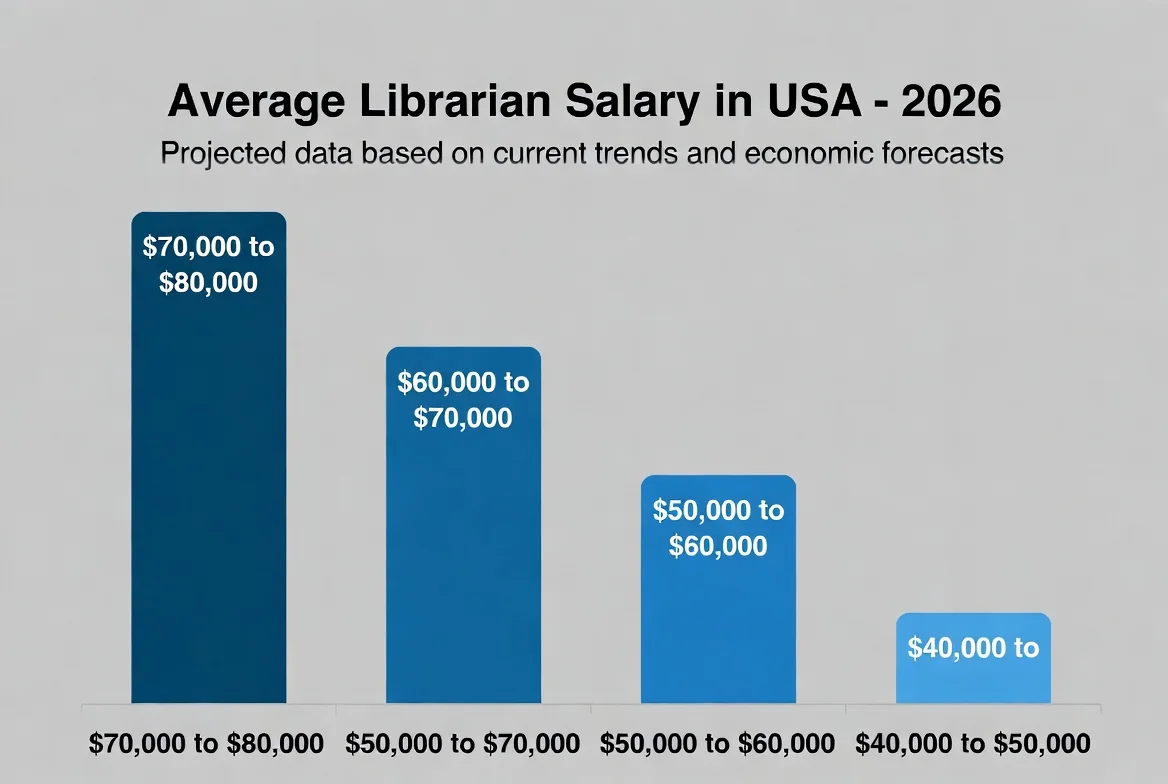
How much does a typical Librarian earn annually in the current economic climate? Based on aggregated data from 7,399 salary entries, the average Librarian salary in the United States for 2026 is $63,346 per year. This figure translates to an approximate hourly wage of $32.06. What is the salary range that frames this average? Entry-level positions, typically requiring a Master of Library Science (MLS) degree and limited experience, start around $53,750 per year. In contrast, the most experienced and specialized Librarians can earn upwards of $82,298 per year. This range highlights the difference between starting a career and achieving seniority with specialized skills or administrative responsibilities.
Which States Pay the Highest and Lowest Salaries for Librarians?
Where should a Librarian work to maximize their earning potential? Geographic location is one of the most powerful factors influencing pay. What is the best way to understand these disparities? The data reveals a significant spread across states.
The top 5 highest-paying states for Librarians in 2026 are:
-
Alaska: $100,000
-
California: $82,701
-
Washington: $78,894
-
Vermont: $69,733
-
Arizona & Massachusetts: ~$69,500 – $68,621
Alaska’s notably high average is often attributed to cost-of-living adjustments and recruitment incentives for specialized positions. How far behind are the lowest-paying states? The bottom 5 states show averages significantly below the national mean:
-
Indiana: $44,756
-
Delaware: $45,136
-
Tennessee: $48,000
-
Montana & Mississippi: ~$49,000
Which factors drive these regional differences? Key influences include state and local funding for public institutions, the cost of living, unionization rates, and the concentration of specialized libraries (e.g., corporate, legal, or medical).
How Do Experience and Specialization Affect a Librarian’s Pay?
Beyond location, an individual’s career path dramatically shapes their salary. What are the best ways for a Librarian to increase their earnings over time? Progression typically follows two tracks: experience level and area of specialization.
Experience Level:
-
Entry-Level (0-3 years): $53,750 – $60,000. Focus is often on public service desks, basic cataloging, and program assistance.
-
Mid-Career (4-9 years): $60,000 – $75,000. May involve managing a department (e.g., youth services, acquisitions), embedded librarianship, or digital asset management.
-
Senior-Level (10+ years): $75,000 – $100,000+. Roles include Library Director, Systems Librarian, Archivist for special collections, or subject-matter expert in fields like law, medicine, or data science.
Specialization:
What is the difference between a general Public Librarian and a specialized one? Specialists often command premiums. For example, Medical Librarians, Law Librarians, and Corporate Research Librarians frequently earn 15-25% more than their peers in public or school libraries due to the required domain-specific knowledge. Digital Preservation, Metadata Architecture, and Data Curation are also high-demand tech-adjacent specializations with strong salary prospects.
What Are the Educational Requirements and Their Impact on Salary?
Is it worth investing in advanced degrees for this profession? The short answer is yes. The standard requirement for most professional Librarian positions is a Master’s degree in Library Science (MLS) or Library and Information Science (MLIS) from a program accredited by the American Library Association (ALA). How much does this degree affect starting pay? Candidates without the ALA-accredited master’s degree are often ineligible for “Librarian” classified roles and are limited to paraprofessional positions (e.g., Library Assistant, Technician), which have a significantly lower pay scale, often capping 30-40% below librarian averages.
What Is the Job Outlook and Future Salary Potential for Librarians?
Should I be optimistic about the future of this career? The profession is evolving. While the U.S. Bureau of Labor Statistics projects slower-than-average growth for traditional librarian roles, demand is shifting and growing in niche areas. What are the top 3 growth areas that will influence salaries through 2026 and beyond?
-
Digital Information Management: Skills in managing institutional repositories, open-access platforms, and digital archives.
-
Data Literacy and Analytics: Librarians who can help patrons and organizations find, interpret, and visualize data.
-
Academic and Research Support: Especially in STEM fields, where managing complex datasets and published research is critical.
This evolution suggests that librarians who adapt by acquiring tech-centric skills will likely see stronger salary growth and job security.
How Do Librarian Salaries Compare to Related Education and Information Professions?
Understanding a profession’s value often requires context. How does the Librarian salary compare to related roles? The data shows interesting parallels and gaps.
| Related Job Title | Average Salary (2026) | Key Difference from Librarian |
|---|---|---|
| Professor | $94,541 | Requires a terminal degree (Ph.D.) and focuses on teaching/research at the university level. |
| Lecturer / Instructor | $71,100 – $49,375 | Often adjunct or non-tenure track teaching roles in higher education, with varying requirements. |
| Lead Teacher / Educator | $71,988 – $65,164 | K-12 teaching roles requiring state certification; pay varies widely by district and state. |
| Library Assistant / Clerk | $35,901 – $56,415 | Paraprofessional roles that do not require an MLS degree, representing a clear career stepping stone. |
The table illustrates that while Librarian salaries are competitive within the broader education and information sector, they generally sit below roles requiring doctoral degrees but above paraprofessional support positions.
What Are the Pros and Cons of a Career as a Librarian Based on Salary?
Is it worth pursuing a career as a Librarian from a financial perspective? Weighing the pros and cons can provide clarity.
Pros:
-
Stability: Employment is often in public, academic, or government institutions, offering strong job security and benefits (pension, health insurance).
-
Meaningful Work: High levels of reported job satisfaction from supporting education, literacy, and community.
-
Clear Career Ladder: Defined paths to higher pay through specialization, management, or advanced technical roles.
Cons:
-
Educational Investment: The required Master’s degree can lead to student debt, while starting salaries may be moderate.
-
Salary Caps: In public institutions, salaries may be constrained by government budgets and fixed pay scales.
-
Geographic Limitation: To achieve the highest salaries, relocation to higher-paying (and often higher cost-of-living) states may be necessary.
Frequently Asked Questions (FAQs)
1. What is the single biggest factor affecting a Librarian’s salary?
While education is the entry ticket, geographic location is often the most decisive factor for salary level. Working in states like Alaska, California, or Washington can result in salaries 30-50% higher than the national average, whereas roles in the Midwest or South may pay less.
2. Do public or private sector Librarians earn more?
It depends. Public school and library salaries are often transparent but may be bound by union contracts and government scales. Academic librarians at private universities and special librarians in corporate or legal settings often have higher earning potential and more negotiation room but may experience less job security.
3. How much does a Master’s in Library Science (MLS) cost, and what is the ROI?
The cost of an ALA-accredited MLS program can range from $30,000 to $60,000+. The return on investment (ROI) is measured over a career. The degree is non-negotiable for professional roles, and the salary premium over paraprofessional positions typically justifies the investment within 5-10 years, especially when combined with strategic specialization.
4. Are there remote opportunities for Librarians, and how do they pay?
Yes, remote and hybrid roles are growing, particularly in digital libraries, metadata services, research support, and corporate settings. Salaries for these positions are often competitive and may be based on the employer’s location rather than the employee’s, which can be advantageous.
5. What is the best way to negotiate a higher Librarian salary?
Should you negotiate? Absolutely. The best way is to come prepared with data on local and national salary averages (like those in this guide), clearly articulate your specialized skills (e.g., grant writing, specific software expertise, foreign languages), and highlight any unique value you bring, such as experience with a particular community or collection.
Disclaimer: The salary data, figures, and career advice provided in this article are for general informational and educational purposes only. Salaries can vary significantly based on individual qualifications, exact job duties, specific employer, years of experience, and local economic conditions. The user is solely responsible for their career and financial decisions.
Keywords: librarian average salary, librarian salary 2026, librarian salary by state, MLS degree jobs, library science career, how much does a librarian make, public librarian salary, academic librarian salary, highest paying states for librarians, librarian job outlook